DSpark: DeepSeek's new speculative decoding work (Video + Blog)
English Video Link: https://www.youtube.com/watch?v=iluBkgFl53E
Chinese Video Link: https://www.youtube.com/watch?v=diorl2YLuO8
0. What is speculative decoding
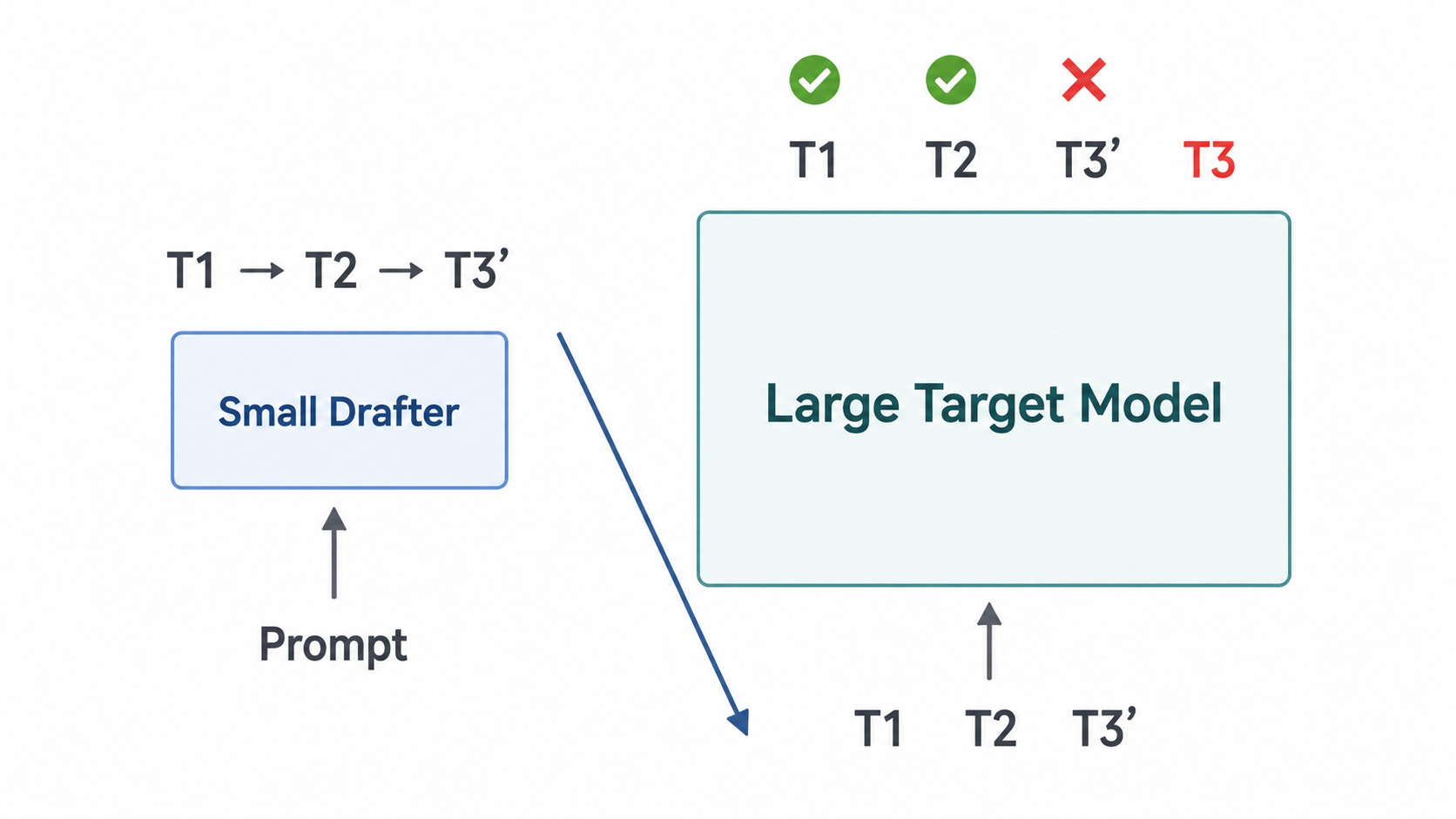
- Drafting: a small drafter model proposes $\gamma$ tokens quickly
- Verification: all $\gamma$ tokens are fed into the target model in one forward pass (similar to chunked prefill)
1. Autoregressive vs Parallel Drafting
Autoregressive
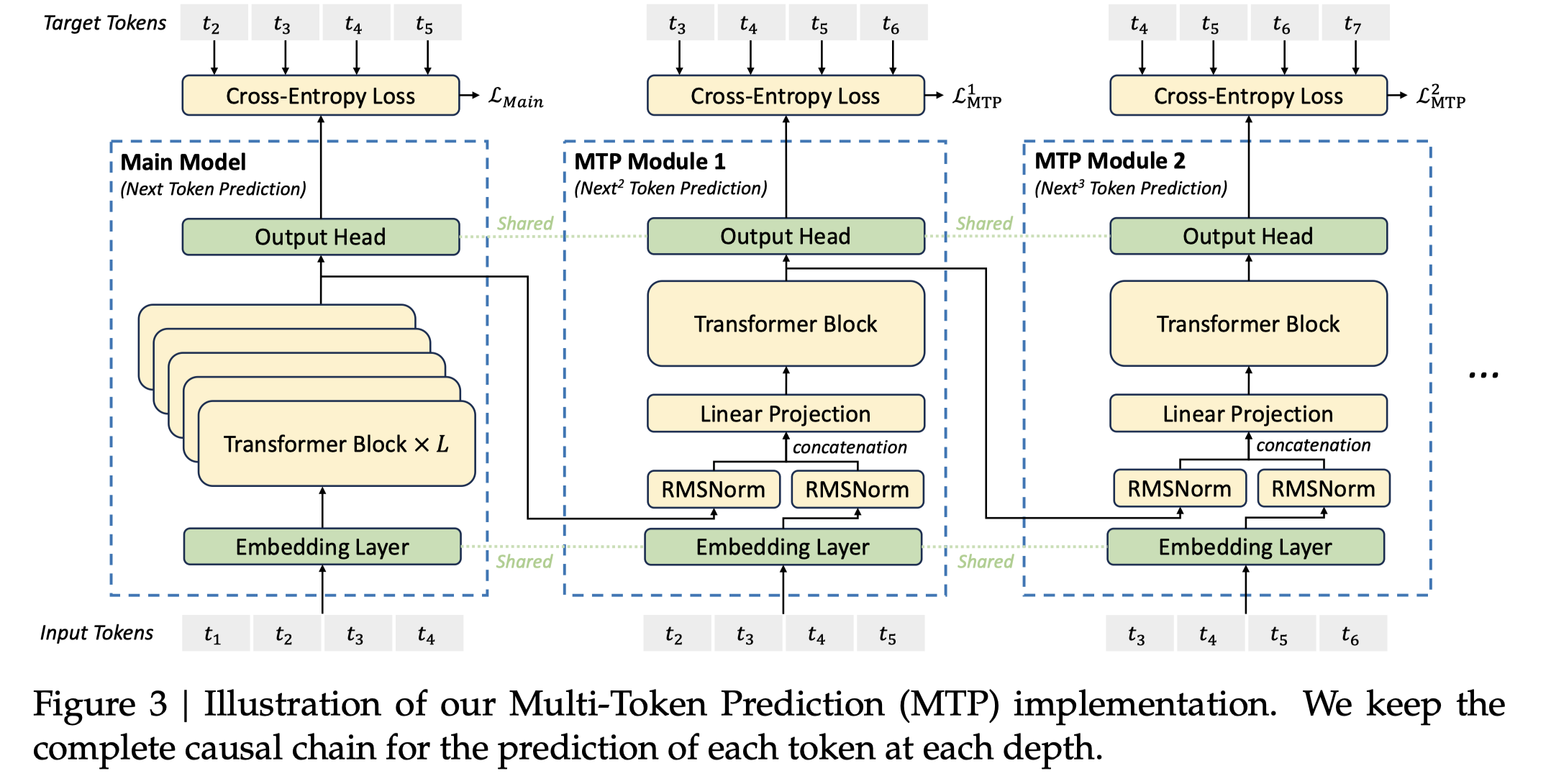
- Representative works: Deepseek MTP, Eagle1/2/3/3.1
DeepSeek MTP (Dec 2024): introduced in DeepSeek-V3, originally for training
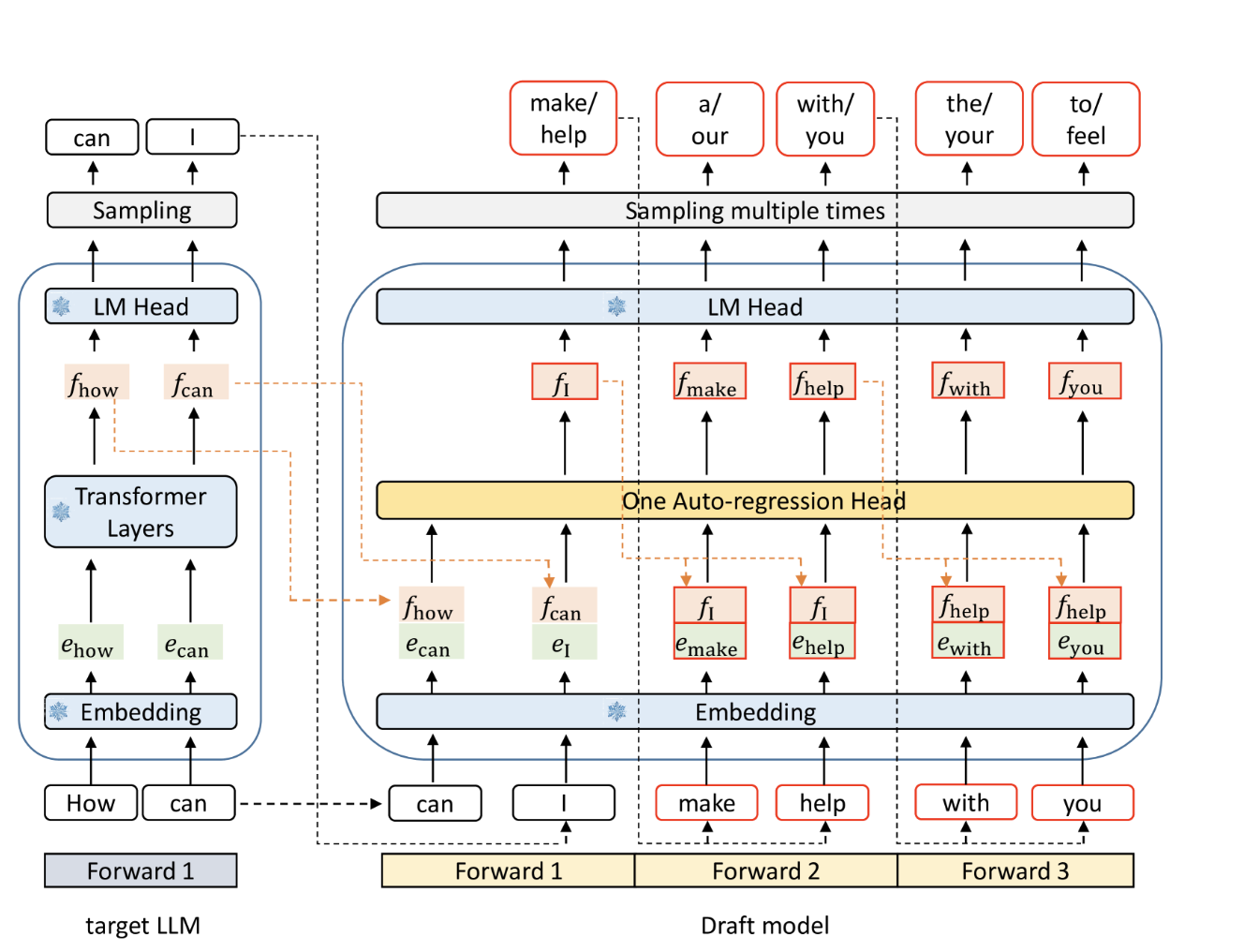
Eagle1 (Jan 2024)
- inference optimization
- next-feature prediction + static tree
Parallel
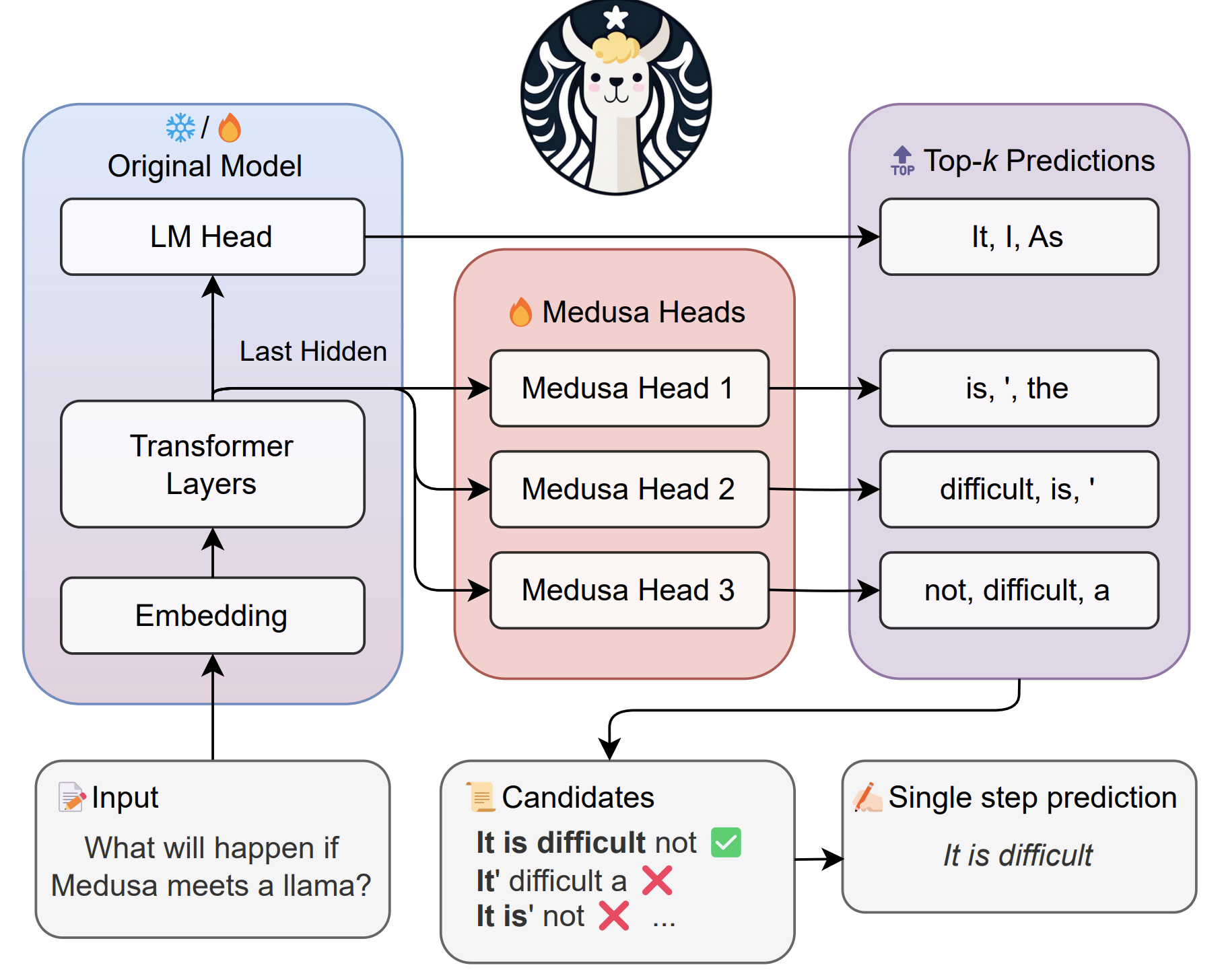
- Representative works: Medusa, DFlash
Medusa (2024)
DFlash
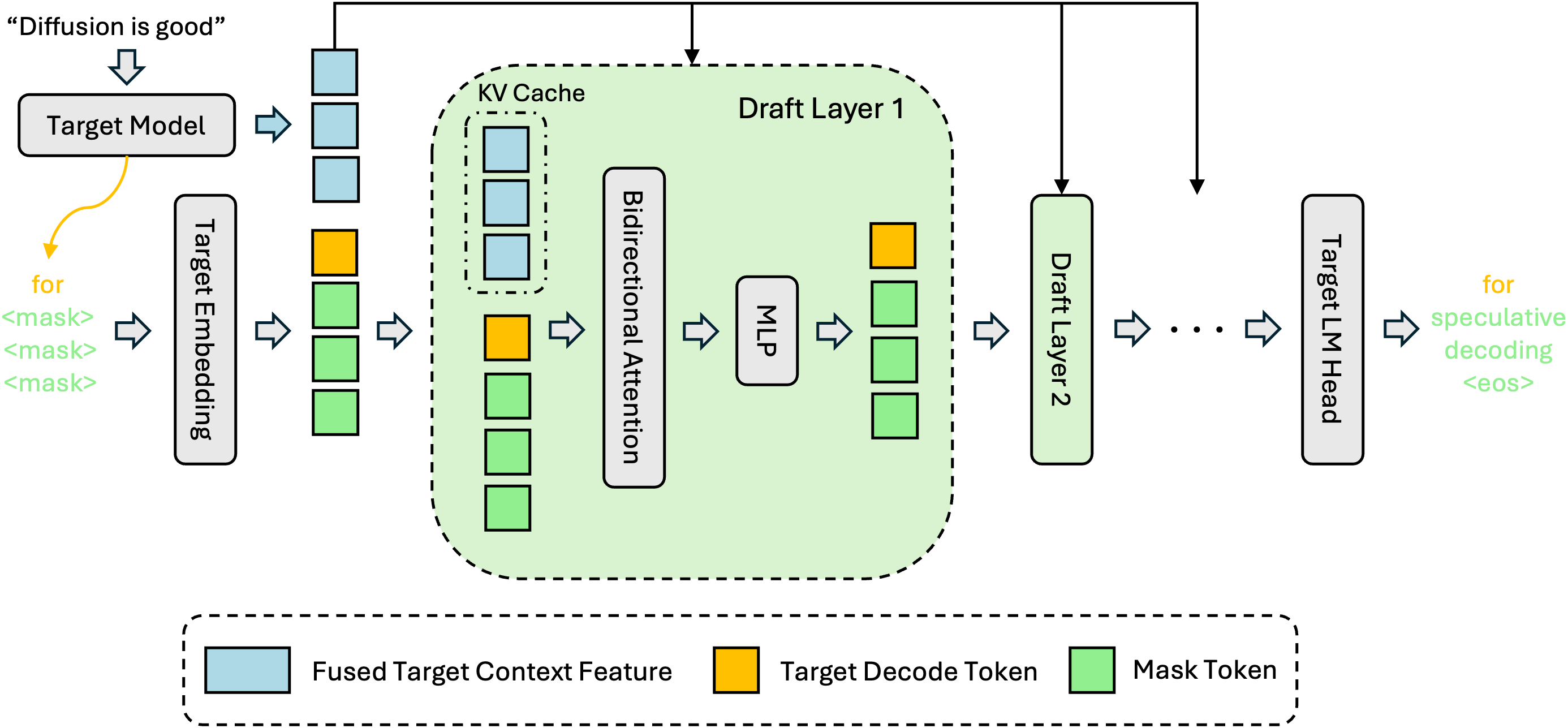
Inputs: the embedding of a bonus (anchor) token followed by $\gamma$ mask token embeddings
Output: logits for all mask positions
Context Feature Fusion: hidden states uniformly sampled from the target model → fuse them using projection

- KV injection: features from the target model are injected directly into the Key/Value projections of every draft model layer and stored in the KV cache

- Bidirectional attention within a block
2. Speedup formula
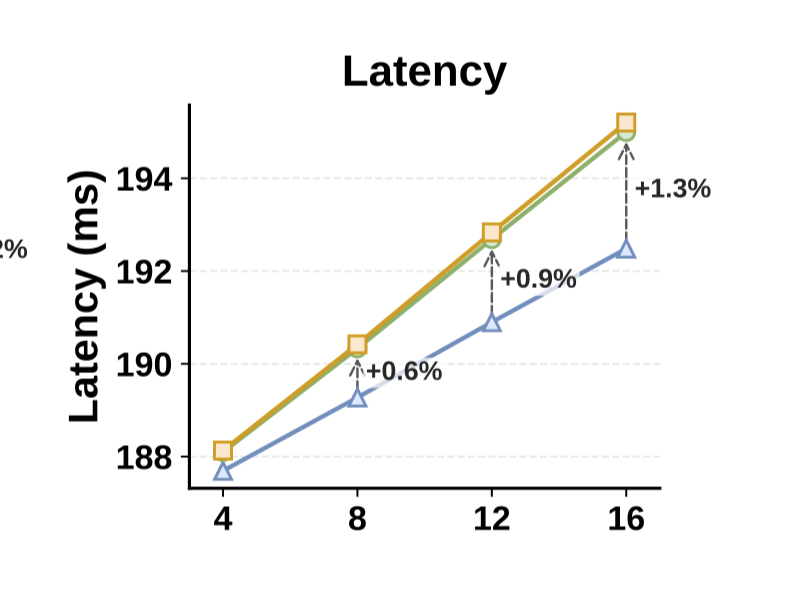
Per-token latency:
$$
\frac{T_\text{draft}+T_\text{verify}}{\tau} (\text{token/s})
$$
DSpark has 3 levers:
- T_draft: parallel drafting
- $\tau$: lightweight sequential module
- T_verify: dynamic verification
3. DSpark architecture
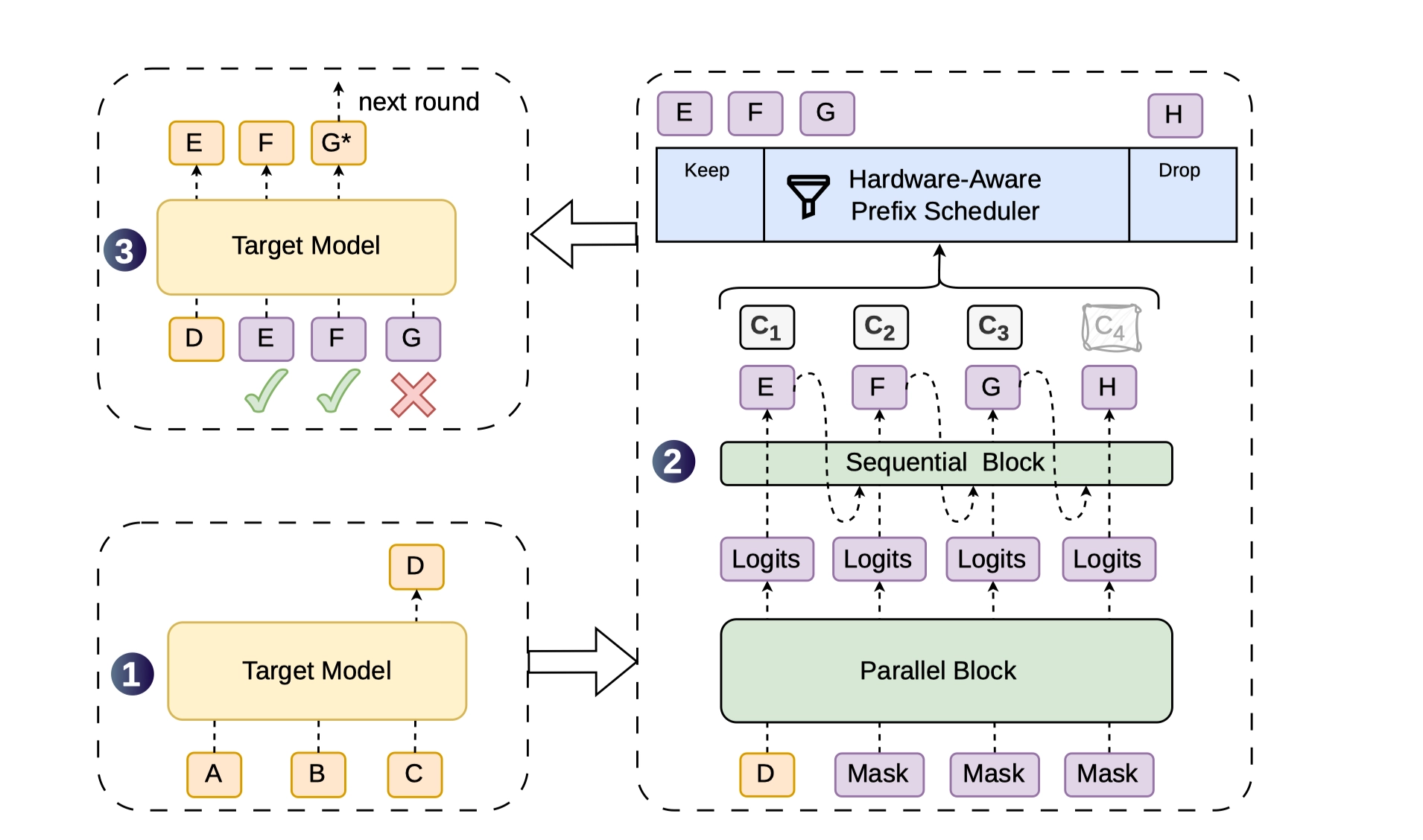
- Inputs: prompt tokens
ABC+ bonus (anchor) tokenD Das the input → a heavy parallel backbone and a lightweight sequential head → draft tokensEFGH+ confidence scoresc1-c4- Hardware-Aware Prefix Scheduler: evaluates
c1-c4scores to retain the prefixEFGand drop HThe - The target model verifies the scheduled prefix in parallel
4. Semi-Autoregressive Generation
Parallel stage
- Use DFlash backbone
- A minor modification: treat the anchor itself as the first prediction position, so $\gamma$ input tokens (anchor + $\gamma-1$ masks) yield 𝛾 draft logits
Sequential stage
- Prefix-dependent transition bias: $B_k(x_0, x_{<k}, x_k)$
- x0: anchor token
- x_{<k}: previous draft
- x_k: current draft
- probability distribution

- $U_k(v)$: base logit vector produced by the parallel backbone at position k
Two instantiations of the sequential block
- Markov head
- first-order transition $B(x_{k-1},x_k)$
- In principle, this is a full $V\times V$ matrix $B$
- In practice, we use a low-rank factorization $B = W_1W_2$
- W1 shape =
[V, r], W2 shape =[r, V]. By default,r=256 - W1: embedding lookup table
- W2: logits projection
- W1 shape =
- RNN head: maintaining a recurrent state that accumulates the full prefix history within a block
5. Confidence-Scheduled Verification
- The confidence head outputs a score c_k for each draft position k
- c_k is the conditional probability that draft 1 to k-1 are accepted
- How to generate c_k? linear projection → sigmod
- Inputs
- backbone hidden state at position k
- Markov Embedding from the previous draft token
- Supervise c_k using the analytical acceptance
Sequential Temperature Scaling (STC)
- Neural confidence estimates are often overconfident
- Calibrate the joint probability consecutively from left to right
- At each position 𝑘 ∈ {1, . . . , 𝛾 }, we perform a simple 1D grid search to find the optimal temperature scalar that minimizes the Expected Calibration Error (ECE) of the cumulative product, keeping the already-calibrated scores of all preceding positions fixed
6. Hardware-Aware Prefix Scheduler
- Existing work: a static confidence threshold
- T_verify depends on system loads (batch size, context length, etc.)
- Formulate as a global throughput maximization problem
7. Training
- cross-entropy loss to predict the correct next token
- distribution matching loss between target and draft distributions
- confidence loss
All three losses are position-weighted (emphasize earlier block positions)
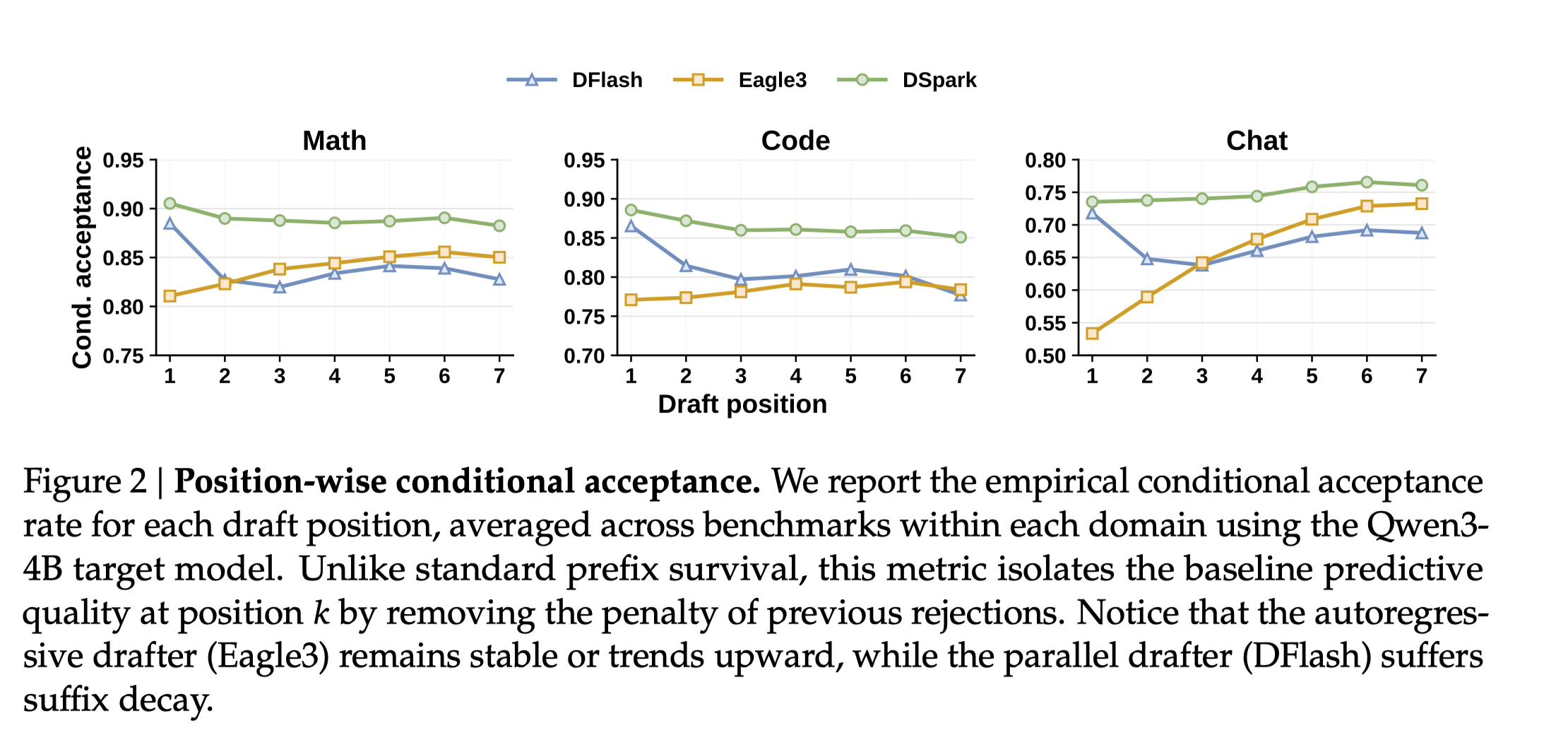
8. Why Can Parallel be Better?
Architecture difference
- Eagle3: one layer due to slow drafting
- DSpark & DFlash: five layers
9. Drafter Depth
Drafter length
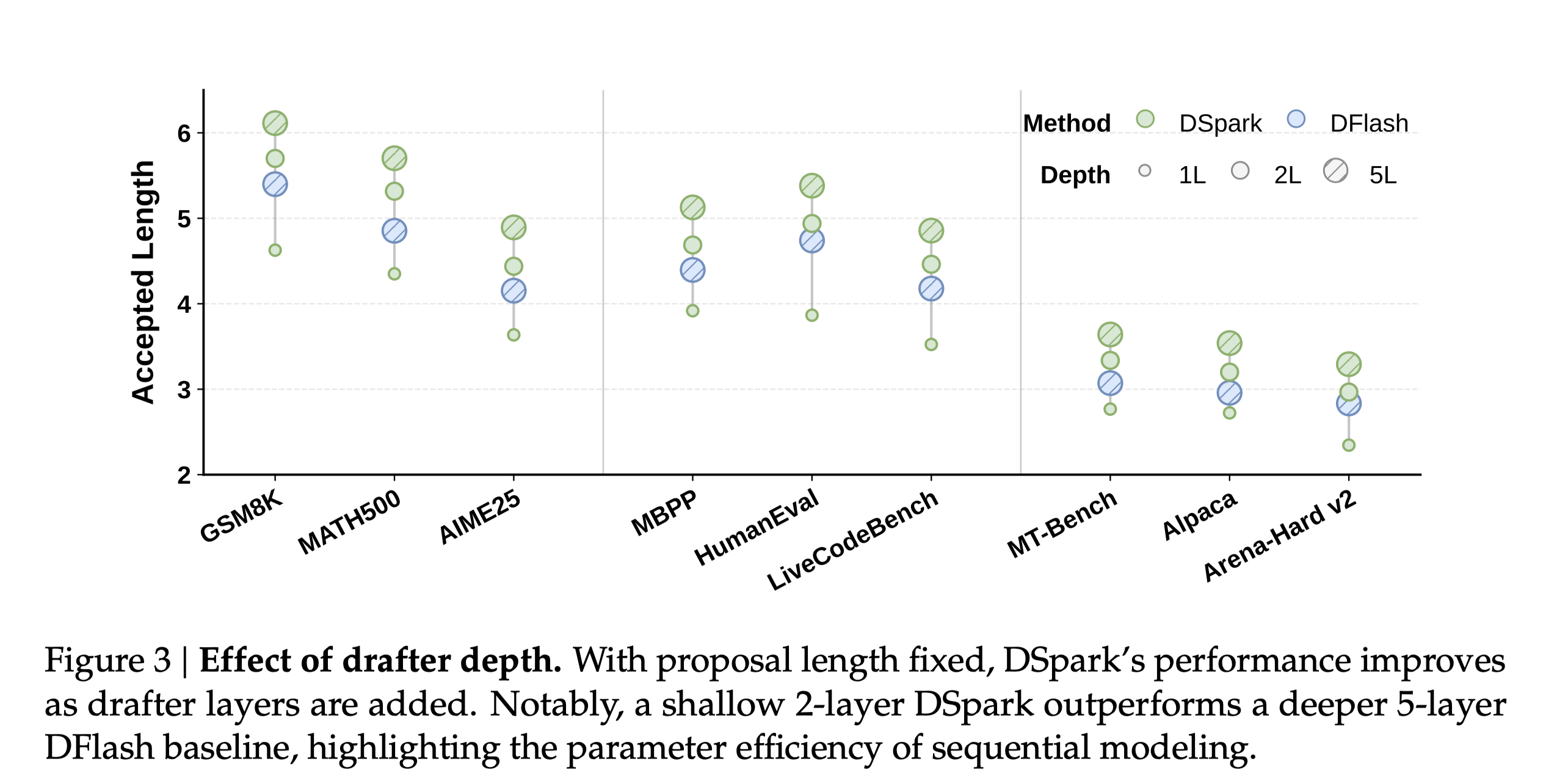
- more layers = larger $\tau$
- 1L to 2L has the largest gain
- 2-layer DSpark outperforms 5-layer DFlash
10. $\tau$ vs Proposal Length
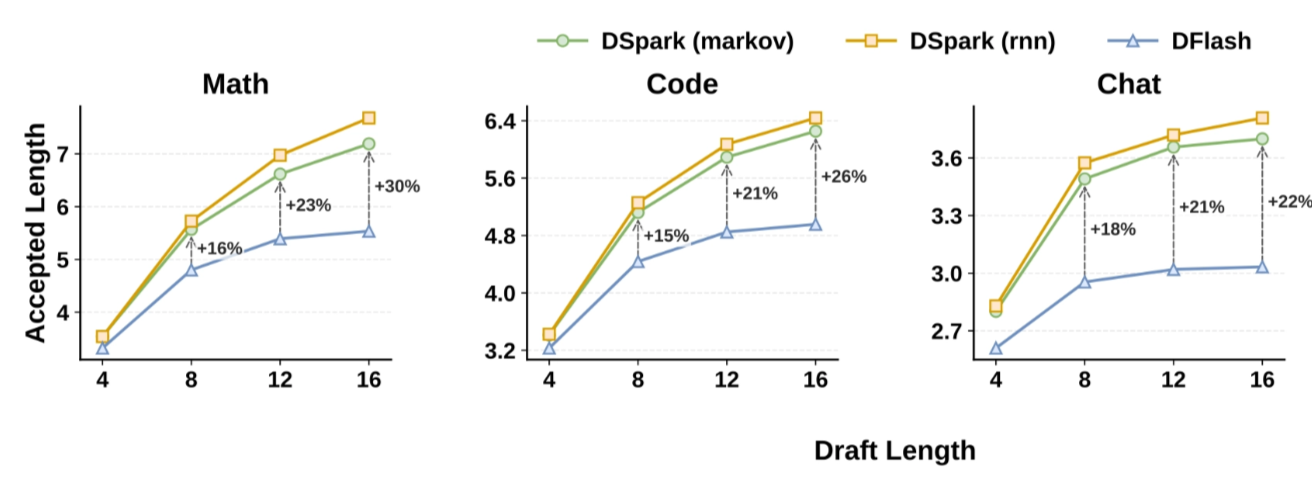
DSpark vs DFlash: performance gap steadily widens as 𝛾 increases
11. $T_{draft}$ vs Proposal Length