Ragged Paged Attention on TPU (Video + Blog)
Chinese Video Link: https://youtu.be/cx-tOvSyjN0?si=i0cdc2cOqUSBiBWD
English Video Link: https://www.youtube.com/watch?v=a6DwNJaN03w
Paper: https://arxiv.org/abs/2604.15464
1. TPU vs GPU
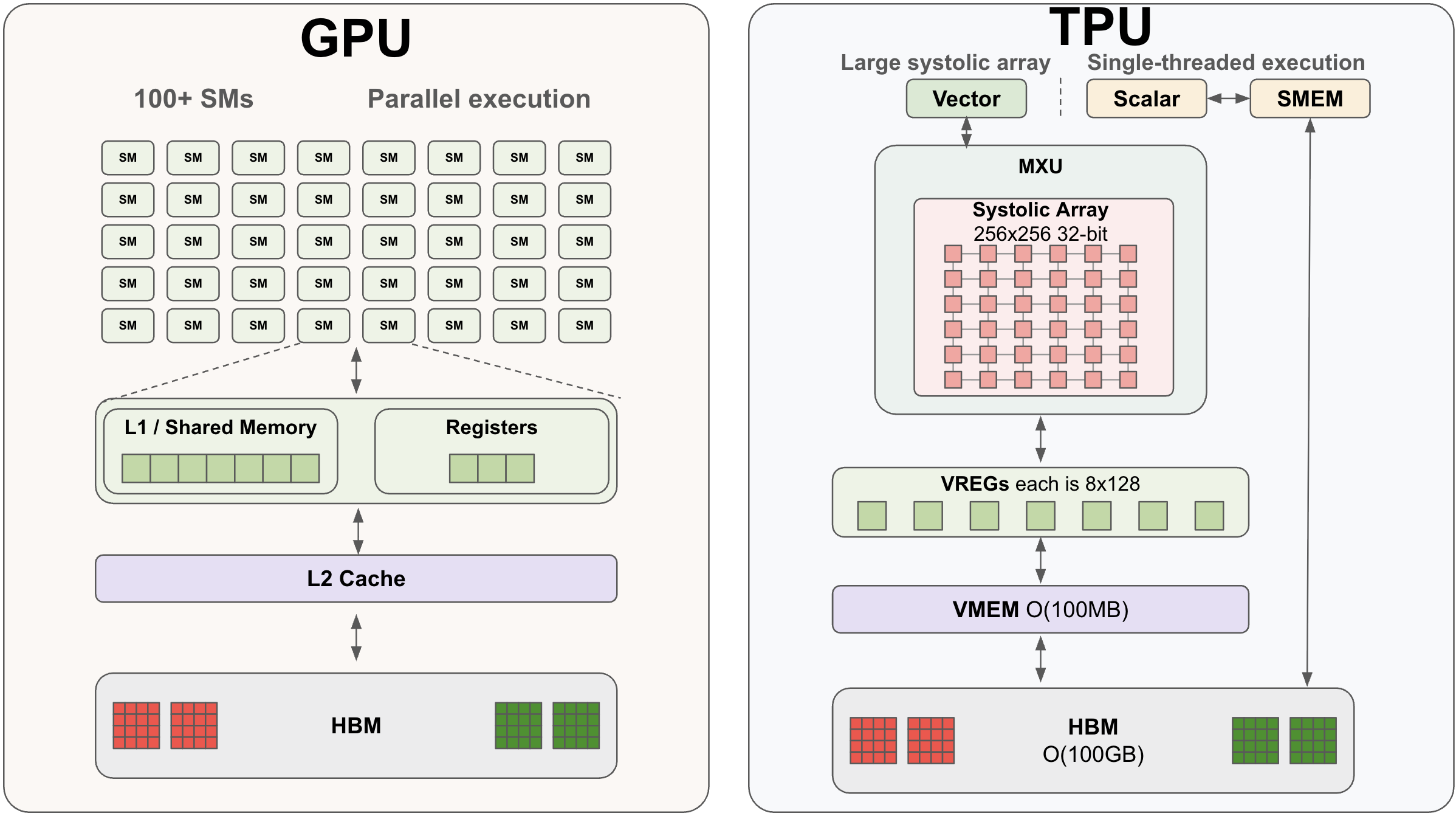
https://jax-ml.github.io/scaling-book/tpus/#what-is-a-tpu
https://jax-ml.github.io/scaling-book/gpus/
TPU 7x key components
- HBM: off-chip high-bandwidth memory
- VMEM: on-chip vector memory w/ direct load/store to VREG
- VREG: Vector register of shape 8x128 w/ 32-bit entries
- VPU: Vector programmable unit. 8x128 SIMD processor in the TensorCore
- MXU: Matrix unit. A 256x256 systolic array for dense matmul
TPU’s unique characteristics
- Less flexible for raggedness
- Systolic array: large. 256x256 32-bit
- MXU: large matmul.
bf16[8,128] @ bf16[128,128] -> f32[8,128]
- Single-threaded execution
2. Challenges for ragged workloads
Dynamic workloads (e.g., various sequence lengths) need raggedness
https://docs.google.com/spreadsheets/d/1pNFg5yrgHdp3ryCIJHMMNbQEOWPKs06zHCzOS-ijMc0/edit?gid=0#gid=0
Ragged Top

- XLA automated optimization for static workloads
- Coarse-grained tiling: padding and wasted compute
- Hard to do fine-grained KV
- Misalignment btw access patterns and layouts? → Communication overhead (scatter, gather)
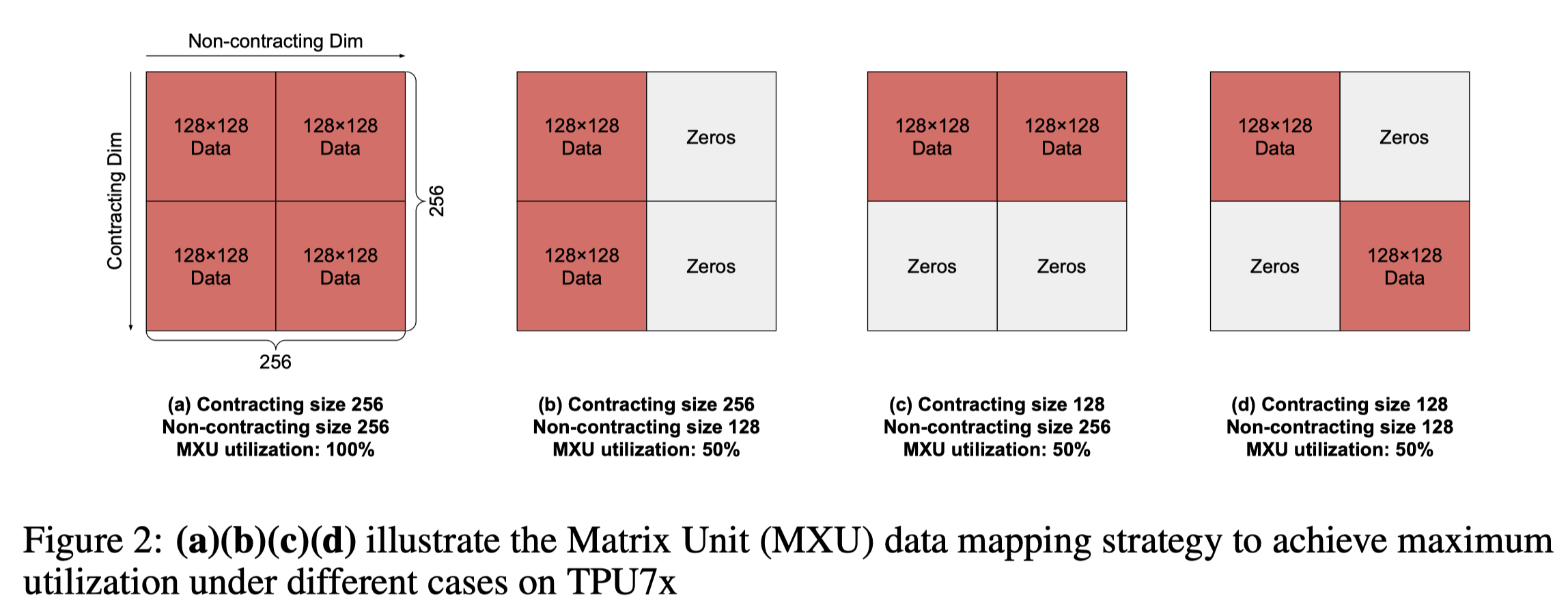
3. Systolic array
MK * KN → MN
4. Tiled layout & packing
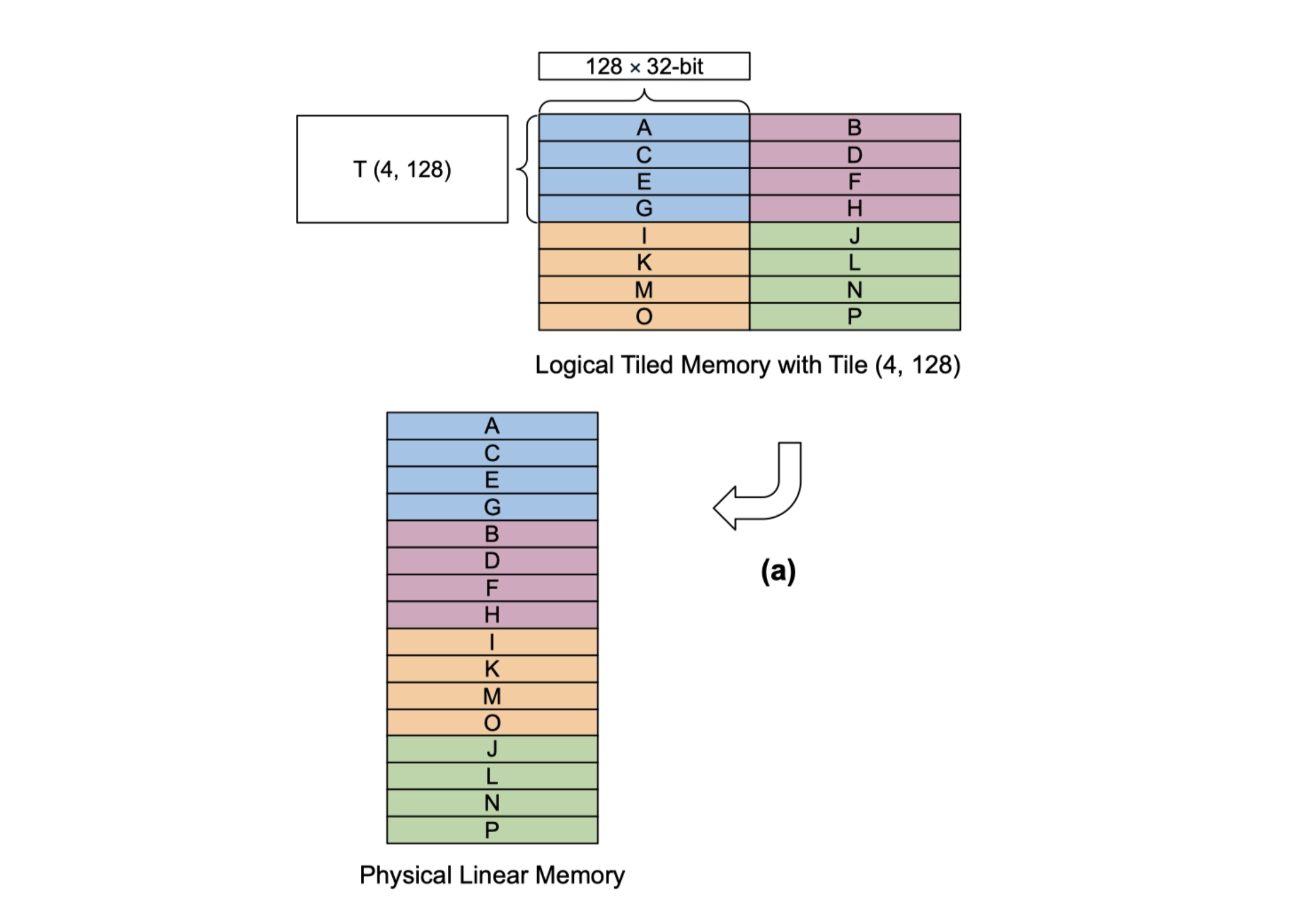
Tiling: split a matrix into several smaller sub-matrices
DMA granularity: 512-byte words (or 128 contiguous 32-bit entries) → tiling cannot be too small
Tiling Example
- Tensor shape = F32(8,256)
- Tile shape = T(4,128)
- 4 “chunks” of 128 entries → matches with DMA; matches with TensorCore width
- logical: row-major order; physical: tiled order
Packing
- For narrow data types (bit-width < 32), TPUs employ packing to improve memory efficiency.
- Multiple elements from adjacent rows of the logical tensor are packed into a single 32-bit “element”
- Lower and higher bits correspond to different rows
F32(7, 200) with T(4, 128) in logical tiled memory
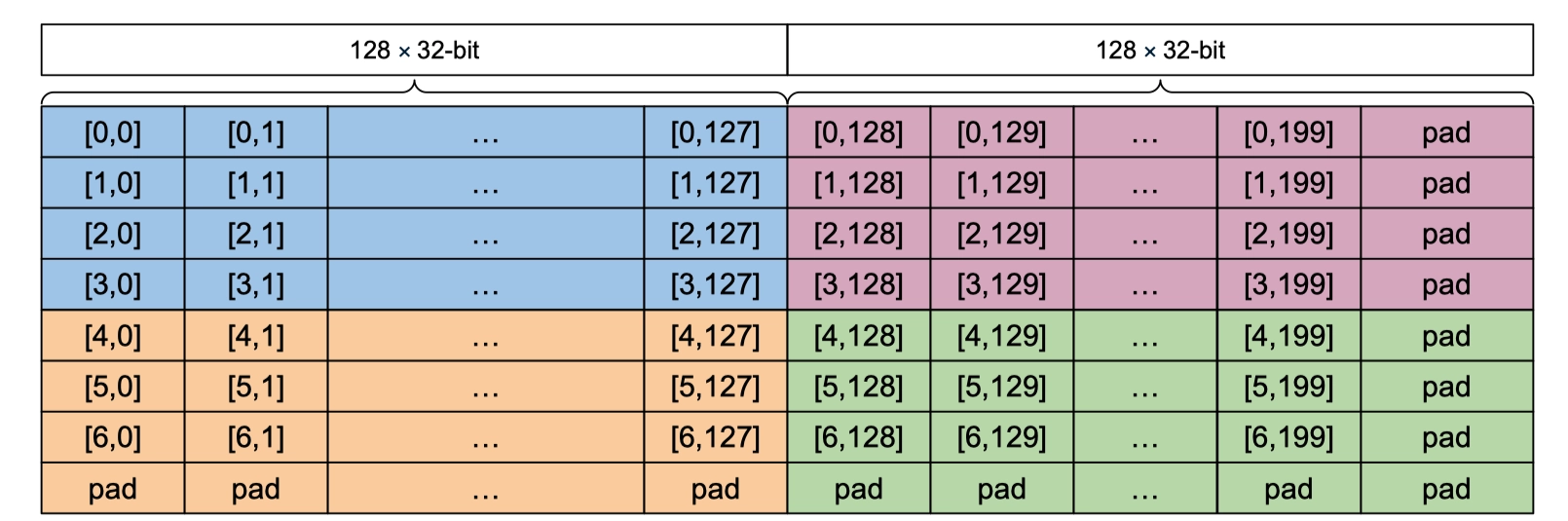
BF16(7, 200) with T(4, 128) in logical tiled memory
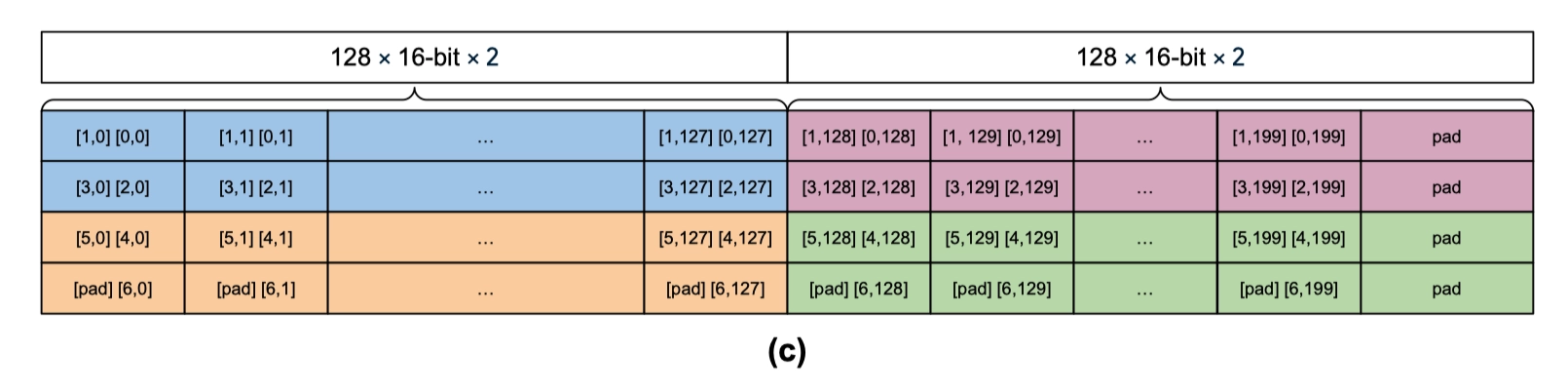
RPA supports efficient dynamic slicing and scatter/gather operations
- placing ragged dimensions along non-tiled axes
- inserting packing as the second minor dimension
https://docs.nvidia.com/deeplearning/nccl/user-guide/docs/usage/collectives.html#gather
https://gdymind.com/2026/02/07/5D-parallelism-in-LLM-training/
5. Single-threaded, double-buffered
- Single-thread execution
- Double buffer: overlap TC compute with DMA
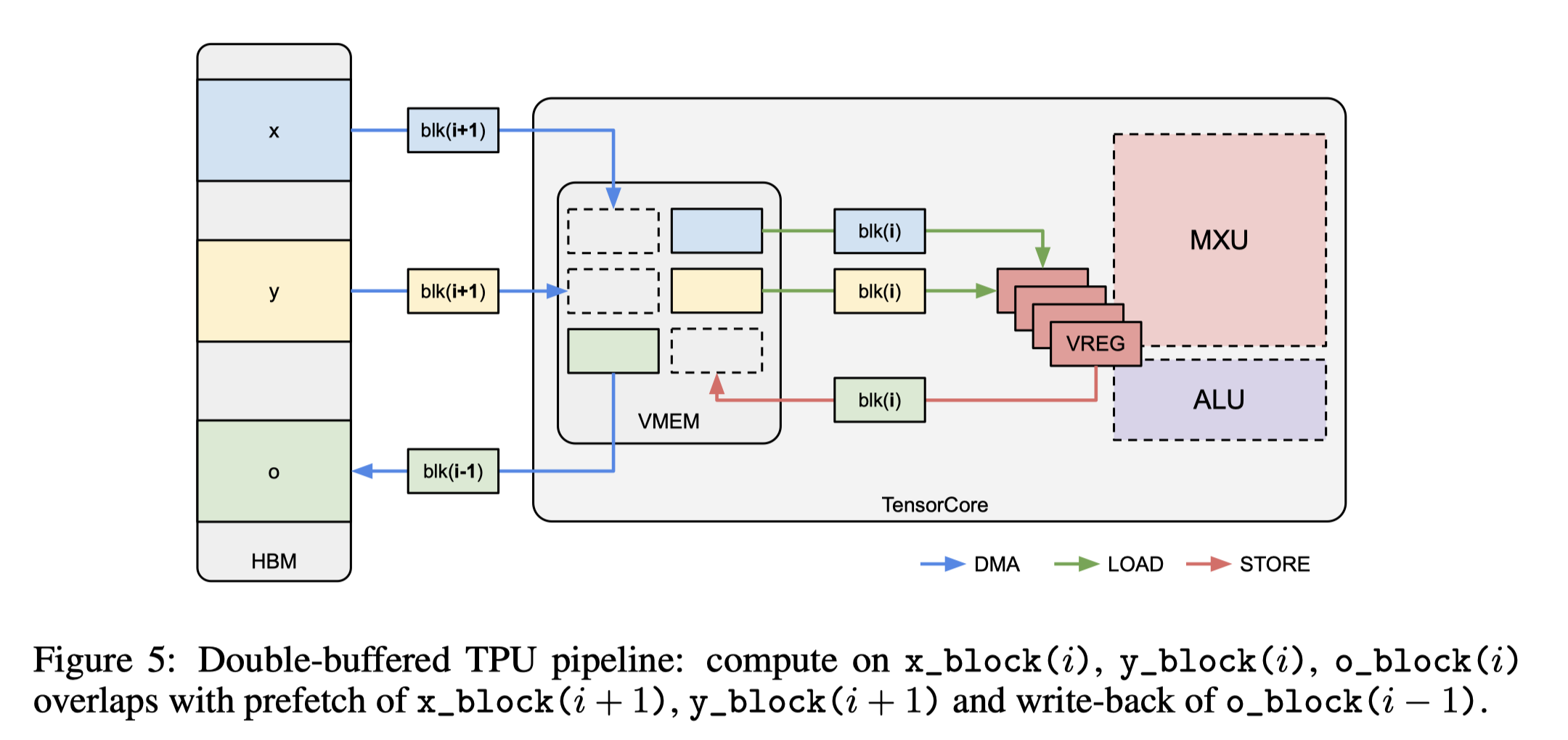
Pallas kernel
- DMA, RDMA: for compute-communication overlap
- Pallas auto-generates multi-buffered pipelines if you don’t explicitly control it
- RPA does explicitly control for pipelining
- Register-level (VREG) compute control
6. vLLM Paged Attention
Paged Attention
Paged Attention: partitions each sequence’s KV cache into fixed-size pages
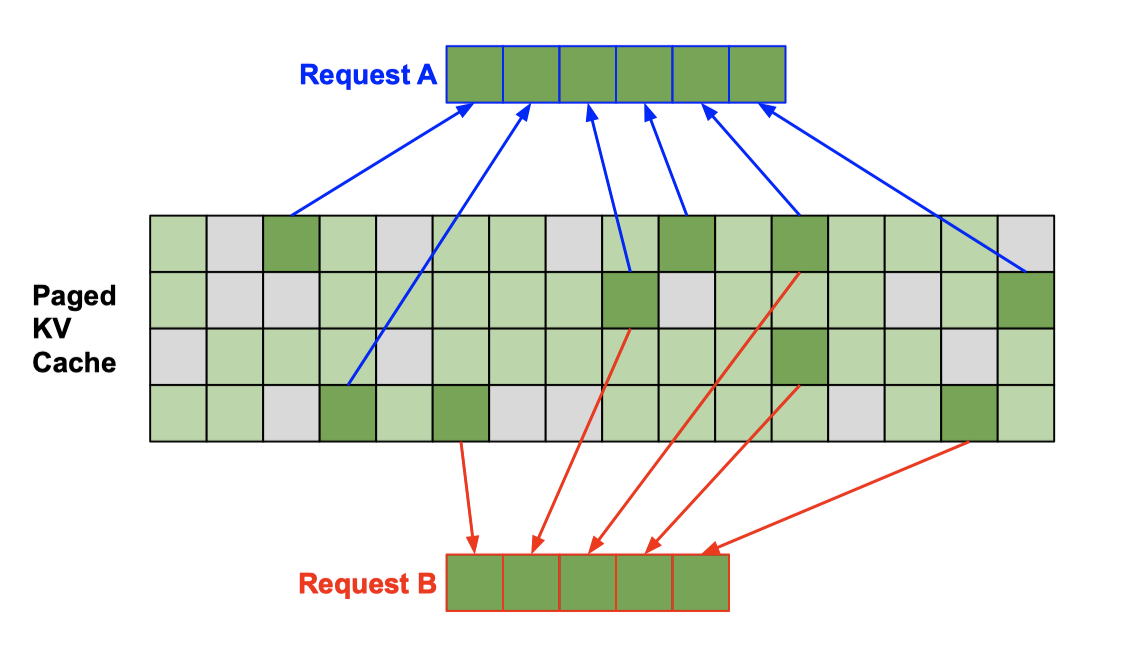
Challenges on TPU: irregular KV memory accesses
- KV reads: need to gather data from non-contiguous addresses
- KV cache updates: ****need to scatter the new KV into partially filled blocks
- single-token updates during decode
Mixed Batch
Prefill and decode can be mixed
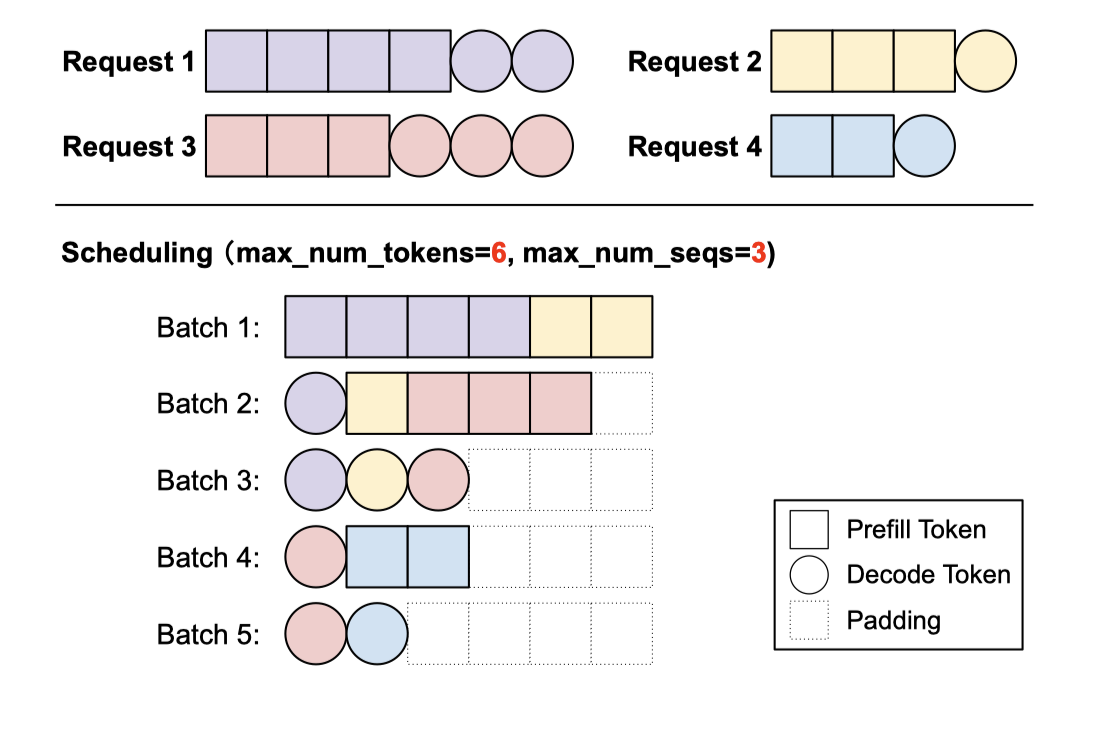
7. RPA: Ragged Paged Attention
- Fine-Grained Tiling for Raggedness: a packing dimension makes tiling finer than XLA’s default (7.1–7.4)
- KV-update-fused Pipeline: overlap KV cache update with attention (7.5–7.7)
- Distribution-Aware Compilation: different sequence lengths? → different kernels (7.8)
- Practical notes: tuning (7.9), quantization (7.10)
7.1 Why XLA’s Default Tiling Fails
It’s hard to enforce tiling in XLA.
- You cannot force it to use
T(1, 128)when XLA has its own decision, likeT(8, 128). - Layouts are fully determined by the XLA’s Layout Assignment pass in HLO
- Tensor shape + data type → XLA determines tiling and padding
A. Loop dimension shouldn’t be tiled
- Q shape =
[BT, N, H]; K, V shape =[BT, K, H]
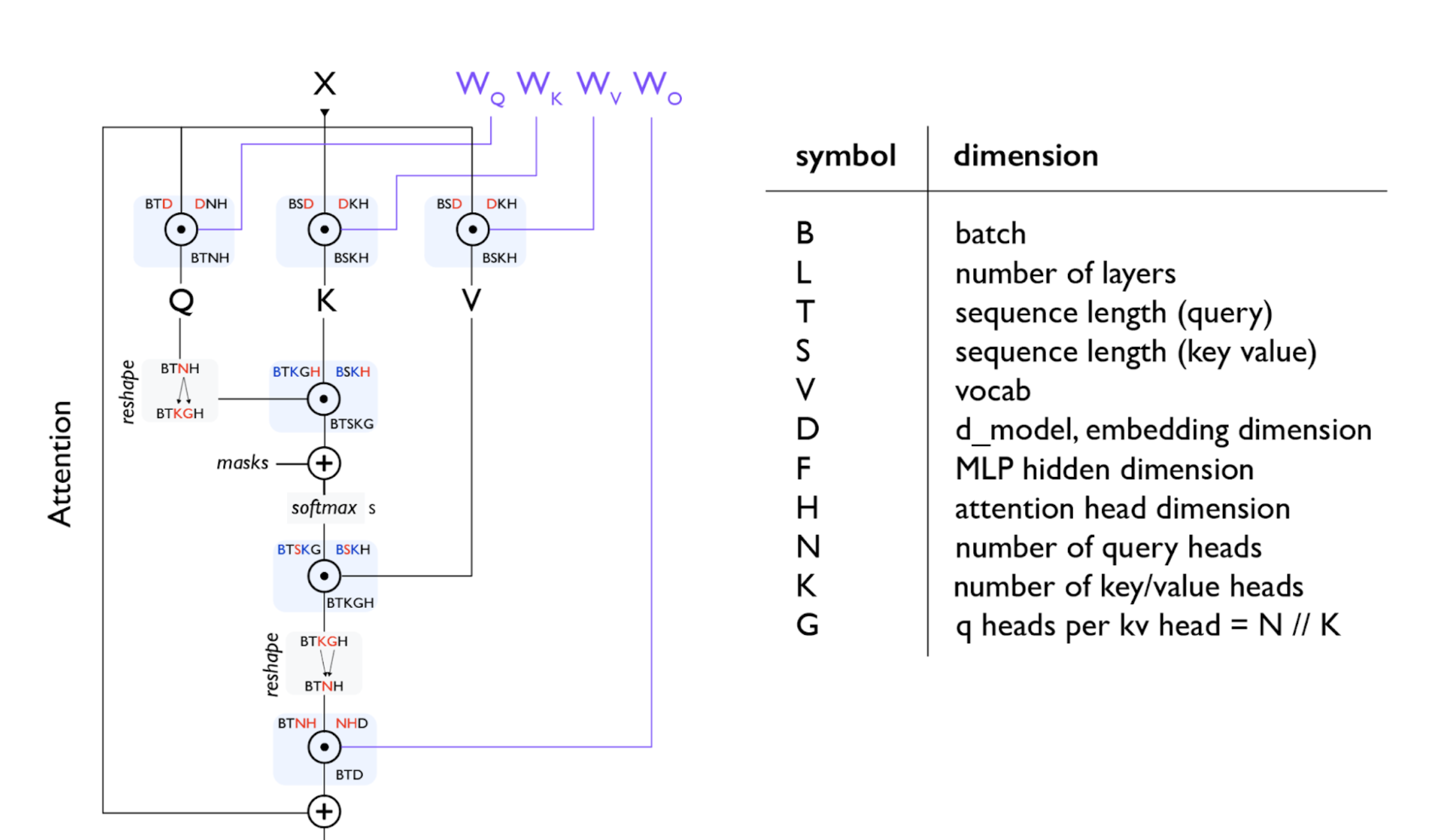
- The last two dimensions are tiled in XLA. For K, V, they are
K, andHin[BT, K, H] - However,
Kis a loop dimension. → It is natural to transpose K and V to[K, BT, H]- For KV, this transpose is never materialized. → It is fused into the loading path (see 7.6)
B. Mixed batch: tiling on dynamic dimensions is inefficient
BTis dynamic → unpacking, blending, and repacking during dynamic slicing → inefficient tiling
C. Head dimensions: implicit padding issue
- Head dimensions (number of heads):
Nin Q andKin K, V
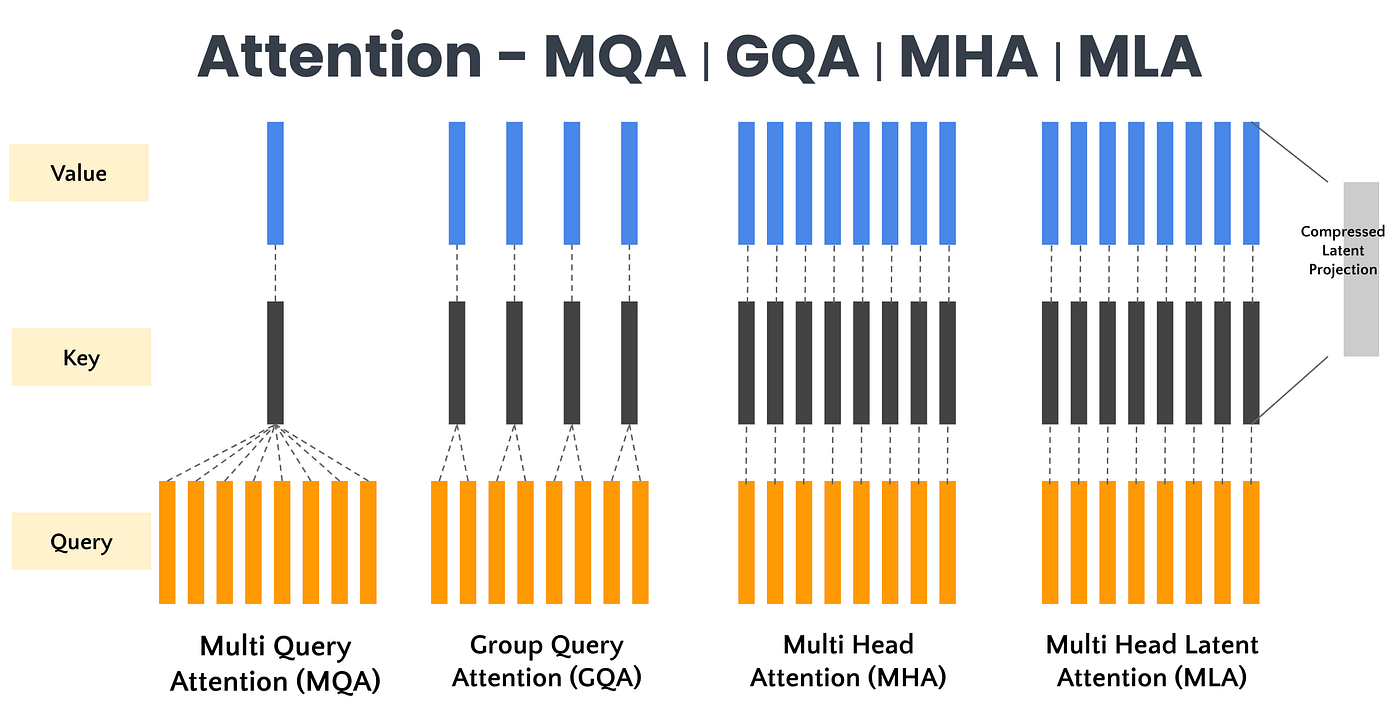
- TP and quantization reduce the number of heads in each chip
- Implicit tiling: cannot reach the minimum
T(packing, 128). Example:T(8, 128)tile- Tensor shape is
BF16(12, 128)→ need to pad toBF16(16, 128) - However, with a smaller tiling such as
T(2, 128), the issue is gone
Solution: RPA introduces a new packing dimension (the 2nd-minor dimension) in Q, K, V → applied to Q in 7.2, to KV in 7.3
7.2 Q Reshape
Since K is the loop dimension (note N = K·G):
- We express Q as
[BT, ⌈KG/P_q⌉, P_q, H] - and transpose it to
[K, BT, ⌈G/P_q⌉, P_q, H]— grouped by KV head first, so each group’sGquery heads are padded to⌈G/P⌉·P_qseparately
Loading Q blocks
- When loading a Q block to VREGs, we reshape it to
[C_q, G, H], allowing multiple query heads within a group to be processed against the sameC_kandC_v. - As a result, the shared
C_kandC_vremain resident in the MXU across all groupedC_q
7.3 KV Merge
- K and V shapes are the same
- It’s common that per-chip
Kbecomes 1 after TP — MQA/GQA keepKsmall to begin with
- With BF16,
P_k= 2 → implicit padding - Solution: merge K and V along the head dimension. Now KV shape is
[BT, ⌈2K/P_k⌉, P_k, H]
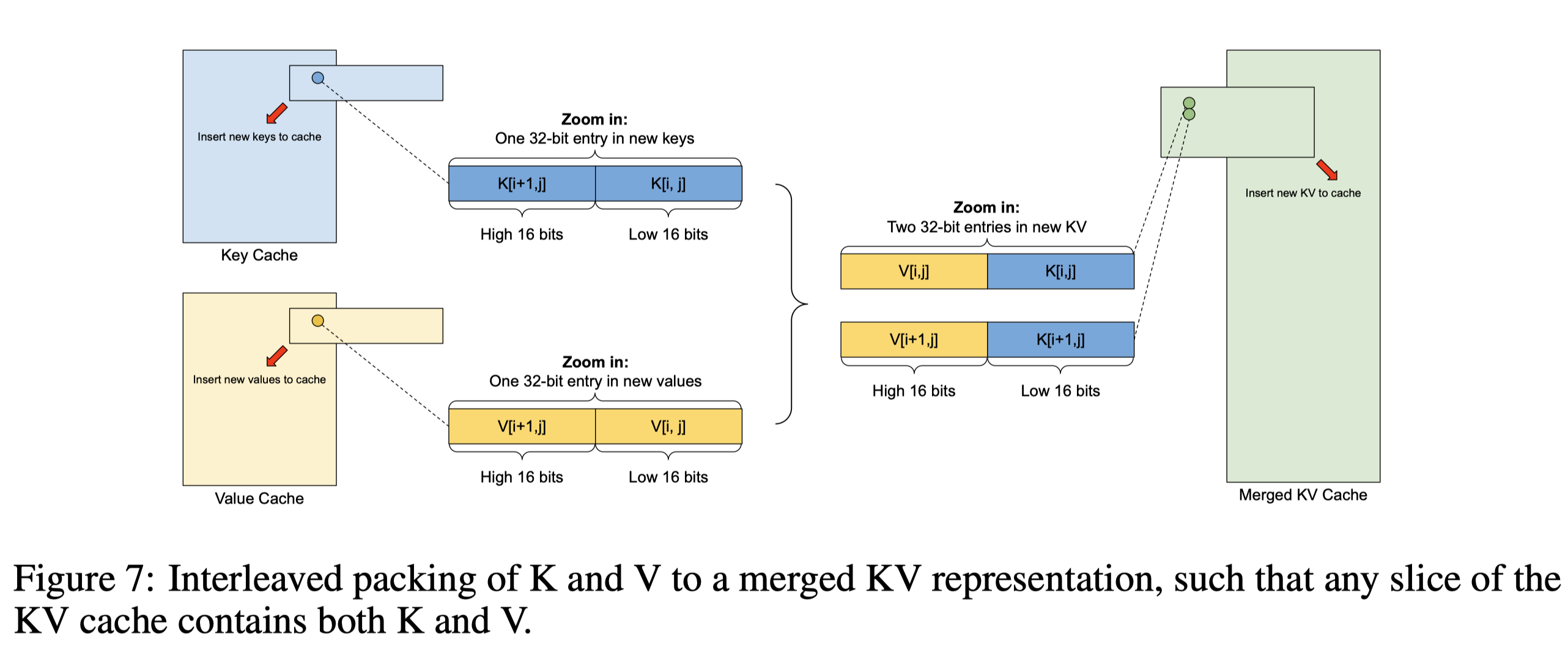
Unpacking cost
- Separating merged
C_kv→ load 32-bit packed value, then unpack & repack intoC_k,C_v - Overhead hidden when it doesn’t interfere with MXU scheduling
- FP8: one 32-bit word holds 2 merged KV elements → repeated extraction per KV head → extra overhead
- Acceptable trade-off: the smallest update unit (single-token slice) contains K and V for all KV heads → efficient transfers
Other benefits of KV Merge
- Reduce the # of vector load/store by half
- Increase the effective DMA transfer size
7.4 Weights: Offline vs Online Processing
Offline idea: reshape & merge projection weights offline → one einsum directly produces Q and merged KV in RPA layouts
W_Q:(d_model, N, H)→(K, ⌈G/P⌉, P_q, d_model, H)W_K,W_V:(d_model, K, H)→ interleaved into(⌈2K/P_k⌉, P_k, d_model, H)
Why it fails: XLA’s Layout Assignment doesn’t preserve T(packing, 128)
- Boundary inputs/outputs of a Mosaic kernel are respected, but intermediate tensors get reordered (implicit transposes)
- Overrides user-specified layout constraints
Solution: defer the transformations to RPA preprocessing (online) to guarantee layout integrity
Future alternatives
- Projection kernel: constrain layouts in a custom kernel → but ops between projection and RPA may still reorder
- Kernel fusion: fuse projection into the RPA kernel → layout never altered
- Layout propagation: if future XLA propagates user layouts to custom kernels → preprocessing eliminated
7.5 Pipeline Overview
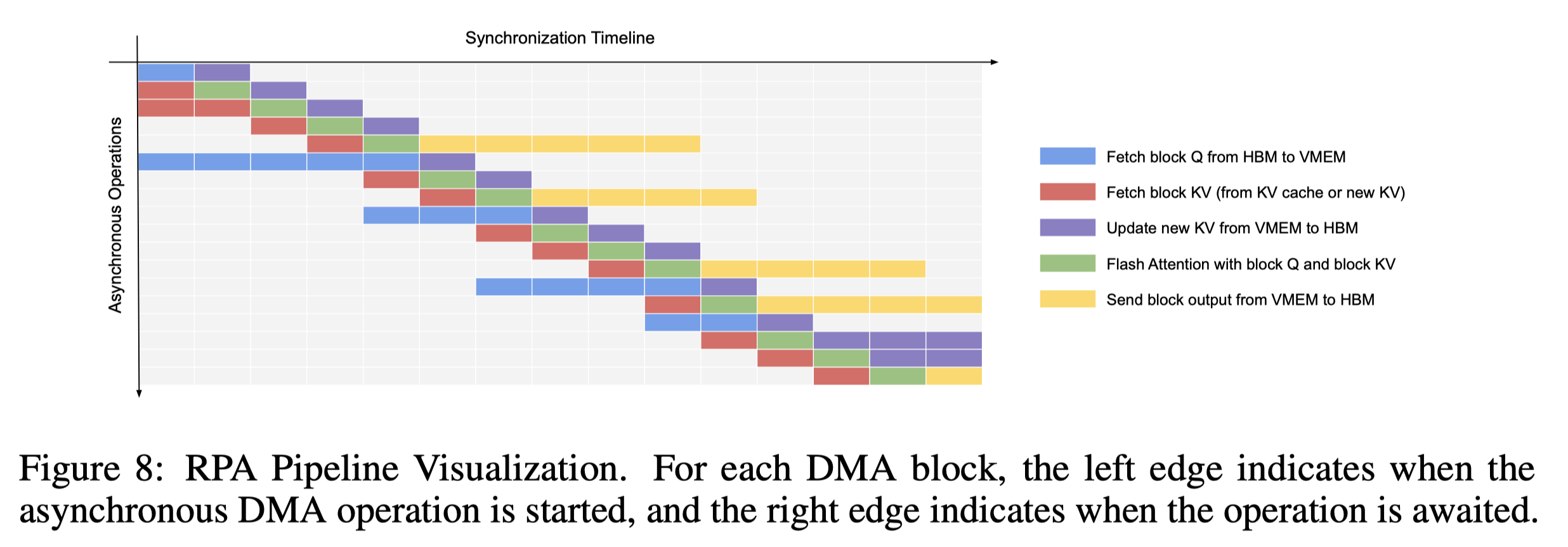
4 types of DMA ops in the pipeline:
- Fetch
B_q: Q block HBM → VMEM, only the effective token range - Fetch
B_kv: gather KV pages via page table (+ newly projected KV) → contiguous block in VMEM - Update
U_kv: write newly projected KV back to the KV cache in HBM - Send
B_o: output block (effective range) VMEM → HBM
Overlapped compute stages:
- Load
C_qfromB_qinto VREGs - Strided loads of
C_kvfromB_kv(transpose fused, see 7.6) - Unpack & repack
C_kv→C_k,C_v - Run FlashAttention-2(
C_q,C_k,C_v) - Store
C_ointo VMEM bufferB_o
7.6 KV Transpose Fusion
K is a loop dimension, not part of the matmul → fuse the KV transpose into the loading path via strided vector loads
- Fetch KV block
(b_kv, ⌈2K/P_k⌉, P_k, H)from HBM into VMEM - Shapecast to a logical view
(b_kv · 2K, H) - Strided vector loads of
(c_kv, H)with stride2K→ transposed layout on-the-fly, no explicit transpose op
Bank conflicts: arbitrary strides → easily cause VMEM bank conflicts → inefficient load scheduling
- Fix: add a small offset in the VMEM block layout so the effective stride is odd
- DMA keeps its effective transfer size; KV loads schedule efficiently
7.7 KV Cache Update Fusion
- Newly projected KV rides along with Fetch
B_kv: appended right after the gathered cache pages, in the same VMEM buffer - Update
U_kvthen reuses that buffer: async write-back to the cache pages, overlapped with attention compute - → no separate cache-update kernel; decode’s single-token updates cost no extra pass
7.8 Distribution-Aware Compilation
TensorCore requires a static number of VREGs to unroll a compute block → the unroll must assume the worst-case query length → for decode (q_len = 1), most of it is wasted
Distribution-aware compilation: pass dynamic indices [i, j, k] to the kernel
- sequences [0, i − 1]: decode-only requests (token length = 1)
- sequences [i, j − 1]: fixed-size-chunk prefill (where prefill length is static)
- sequences [j, k − 1]: mixed-batch requests
- a post-scheduling reordering algorithm guarantees this order: all decode-only and prefill-only requests are placed at the front
Per-case specialization:
- decode-only & prefill-only: the query block size is known at compile time, allowing the kernel to statically determine VREG usage and schedule computation efficiently
- mixed: must accommodate unknown effective lengths, potentially leading to wasted compute resources due to padding
Avoiding recompilation
- JIT enforces static shapes
- RPA defines the maximum number of tokens and the maximum number of sequences; input data is padded to these upper bounds
- → shapes stay stable across steps, no recompilation at serving time
7.9 Tuning
4 tunable block sizes:
b_q,b_kv: improve DMA–compute overlapc_q,c_kv: reduce VREG pressure / spilling (smaller compute blocks)
Tuning depends on: TPU generation & topology, model (head dim, context length), workload distribution (sequence / generation lengths)
3 sets of block sizes per workload type:
- Decode-only: memory-bound → saturate memory bandwidth
- Prefill-only (with fixed-size chunked prefill): compute-bound → maximize MXU utilization, minimize VREG spilling while maintaining high MFU
- Mixed: hardest; tune for the common case if partially known (e.g., mostly short KV lengths)
Recommendation: tune offline → lookup table → applied at pre-compilation during server bring-up
7.10 Quantization
- RPA supports per-tensor quantization
- No per-channel or per-head quantization yet → need more kernel modifications